Gender gaps in caregiving persist even where policy incentives for equal parenting are strong. This paper asks whether gender
norms shape how couples divide paid work and care after a birth, and whether their effect operates independently of economic
incentives. Using Norwegian administrative data, I measure a woman's exposure to gender norms by the share of her high-school
peers whose mothers worked full time, and identify its effect from within-school, across-cohort variation. A one-standard-deviation
increase in exposure raises women's full-time work after childbirth, raises their partners' take-up of the full paternity quota,
and lowers the share of fathers who concentrate leave in summers and holidays, a pattern that minimizes career costs while
providing little additional care. The transmission is asymmetric: men's own peer exposure has no effect on their leave or on
their partners' outcomes. More-exposed women could shift their partners' behavior through greater bargaining power or through
whom they partner with. The effect on fathers' leave holds at every level of the woman's share of household income, a proxy for
her bargaining power, so it is not explained by economic incentives alone. Instead, more-exposed women partner with men who are
more educated, from higher-SES families, and more likely to have had a working mother themselves.
We study which characteristics differentiate the group of women who reach the top of the earnings distribution by their
mid-30s. Using Norwegian administrative registers for the 1983–1988 cohorts, we define “elite women” as those in the top decile
of the economy-wide annual earnings distribution at age 35. We track earnings trajectories from ages 20 to 35 and decompose the
gap between elite women and other women using a sequential matching design that equalizes family background, academic
performance, educational attainment and field, early occupational placement, fertility, and job mobility. We show that earnings
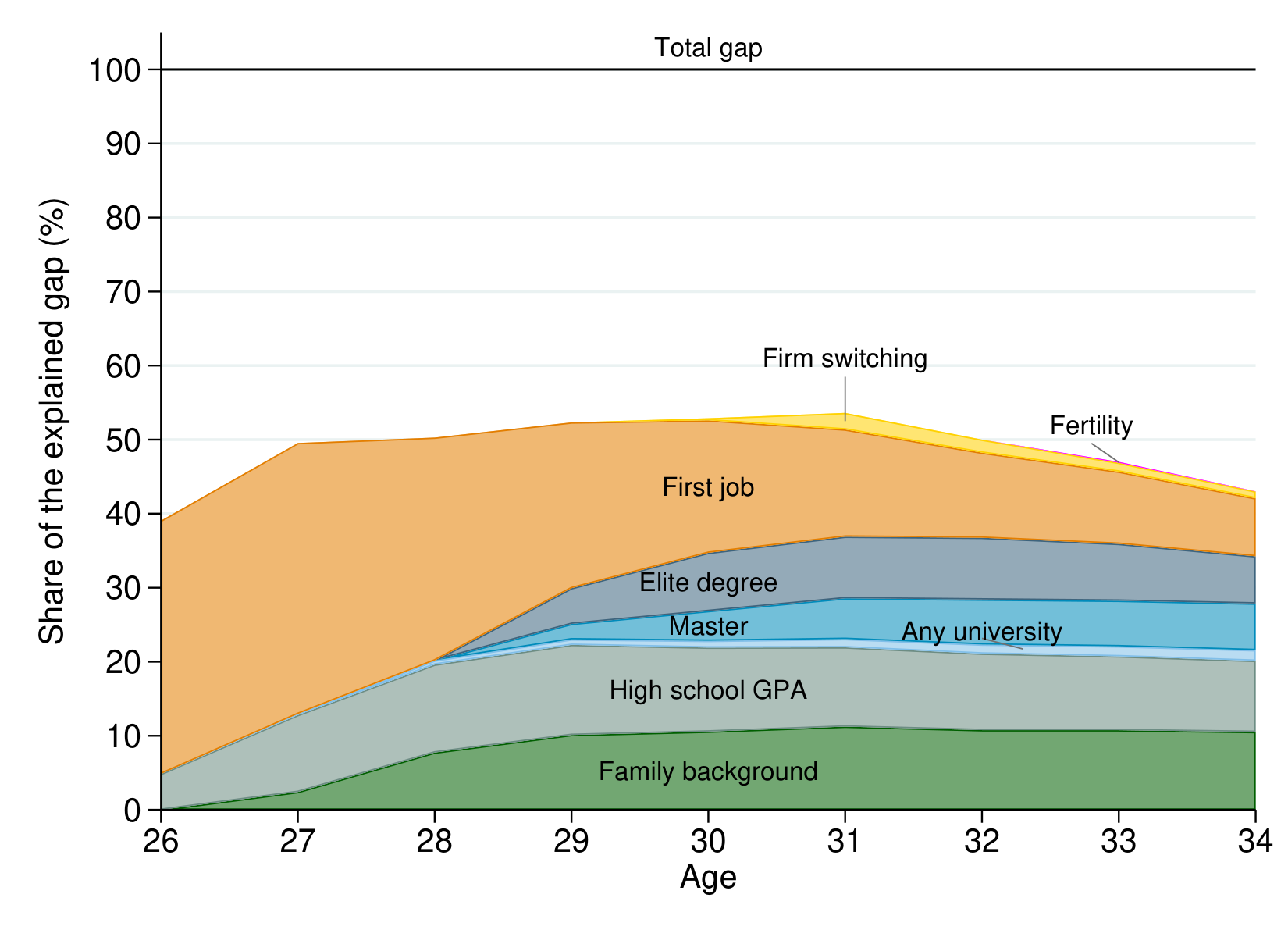
gaps emerge immediately after labor market entry and widen rapidly through the early career. About 45 percent of the gap between
elite women and other women is explained by observable characteristics. Family background and high-school achievement account
for a large share, and early occupational sorting further amplifies these differences. Fertility instead explains only a limited
share of within-gender earnings inequality. Roughly 55 percent of the gap remains unexplained by observables. Our findings shift
the focus from gender gaps per se to within-gender inequality at the top of the earnings distribution. They highlight the central
role of early-life conditions, educational specialization, and initial career sorting in shaping women’s success at the top.
Share of the earnings gap between top-10% women and the rest accounted for by each set of characteristics, by age.